Grow like you know what you’re doing.
You want the perfect indoor environment to optimize the genetic capability of your grow — so do we. The perfect environment is, of course, unobtainable. It is still worth pursuing. Croplock is a system that watches your grow tent for you, keeping a camera on your grow, and reading the air temperature, humidity, light level, and most important: the leaf temperature. If you assign equipment using smart plugs, it can signal those to operate in the pursuit of the perfect environment. Croplock steers conditions inside the tent, and keeps a constant lookout for problems. When it can’t tell if there’s a problem or not, it tells you it can’t tell instead of inventing some answer that sounds plausible. But when it can tell, it does — even optionally by an email message so you can keep on top of things even when you’re not home. Moreover, it keeps everything on the device, in the privacy of your own home, no cloud, no account, no subscription — all the while recording your grow journal, good and bad, so you can review each daily chapter when you get back from the weekend.

Know what happened while you were gone.
No single bad reading e-mails you. The tent has to drift out of its band and stay there — 45 minutes, longer than the loop’s own correction takes — and then you get one message: what’s wrong, and what to do about it.
Some things get one e-mail each. The light on at 2 a.m. The camera gone quiet. A smart plug that stops answering, which the hub re-adopts on its own and then tells you about — that one ran unattended on our bench at 7:34 one morning, before anyone was up.
If the camera calls something on a plant it can name — male flowers, powdery mildew, a pest — the e-mail carries the frame it saw, so you can judge the call from your phone. Overnight findings wait for morning.
Alerts are off until you turn them on. What you fed and watered is yours to add, and the page keeps a line for it.
Six pages, turned back and read
Shot live from the bench tent. Open the device on Friday, turn back to the Saturday you left, and read forward: your one line, what the leaf and the fan did each day, the canopy coming down and the page saying so, and the morning the camera called first pistils — with the pod that saw it named. Nothing to reconstruct.
It tells you when it can’t tell.
Most grow tools have two things to say: something is wrong, or nothing is wrong. That leaves out the answer you most need to trust them — I looked, and I couldn’t tell.
Your Croplock keeps four answers apart, and it writes down which one it gave, every time:
- It read something — and the record shows whether you then confirmed it or waved it off.
- It’s watching — reading, but the conditions for any verdict aren’t there yet.
- It held back — it saw something and stayed under its own confidence floor on purpose.
- It couldn’t read the leaf — the frame didn’t support a judgement at all.
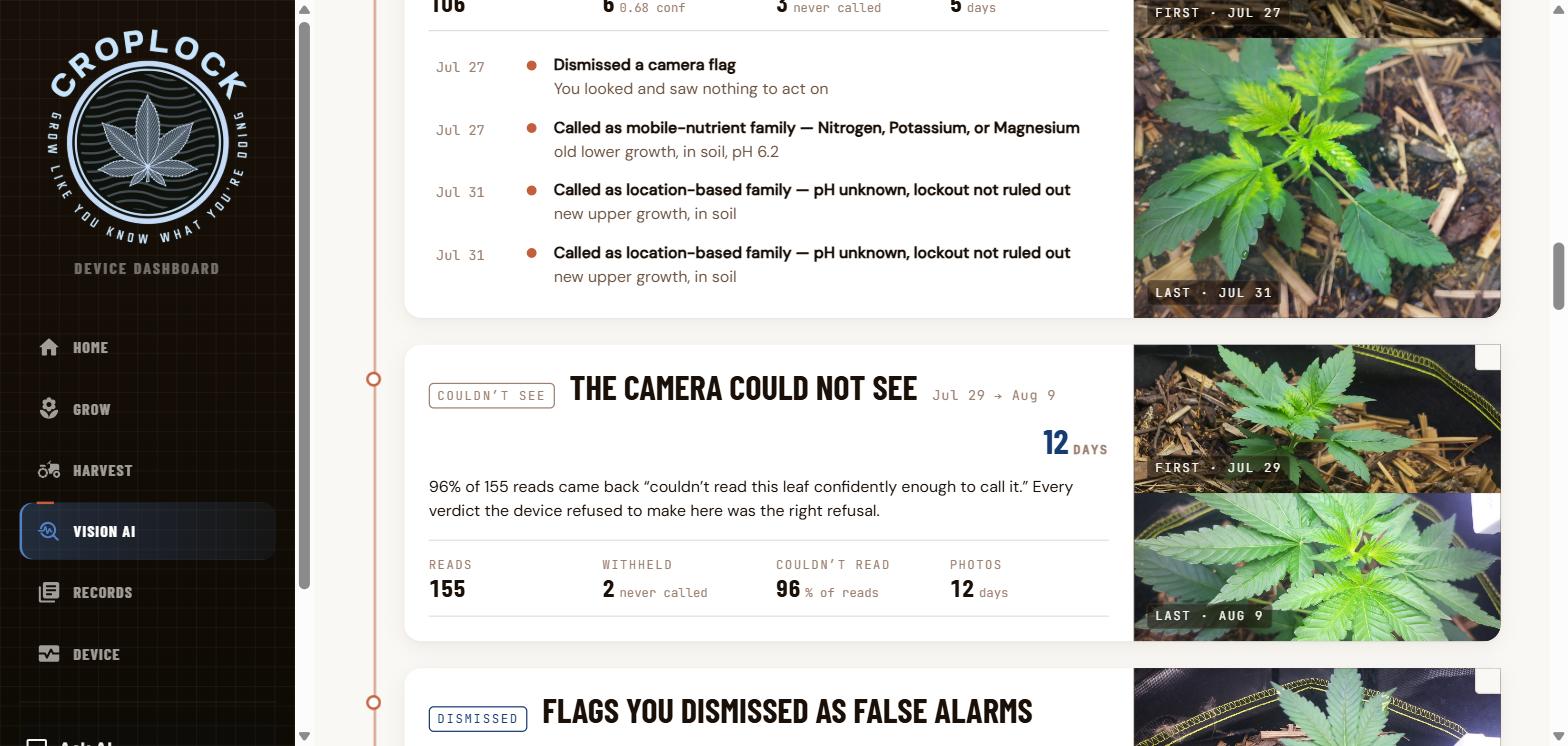
That last one is the one nobody else shows you, and it is the difference between a tool you can leave running and a tool you learn to ignore. Twelve days on this plant, the camera could not get a confident read, and it said so — instead of twelve days of a reassuring green tick.
Every read comes with the count behind it
You are never shown a finding on its own. A block says 106 reads · 6 of them read deficiency at 0.68 confidence · 3 held back · photos on 5 days — so you can see for yourself how thin or how solid it is. Six times out of a hundred and six is a different thing from six times out of eight, and you get to be the one who decides which.
And your call goes in the record too
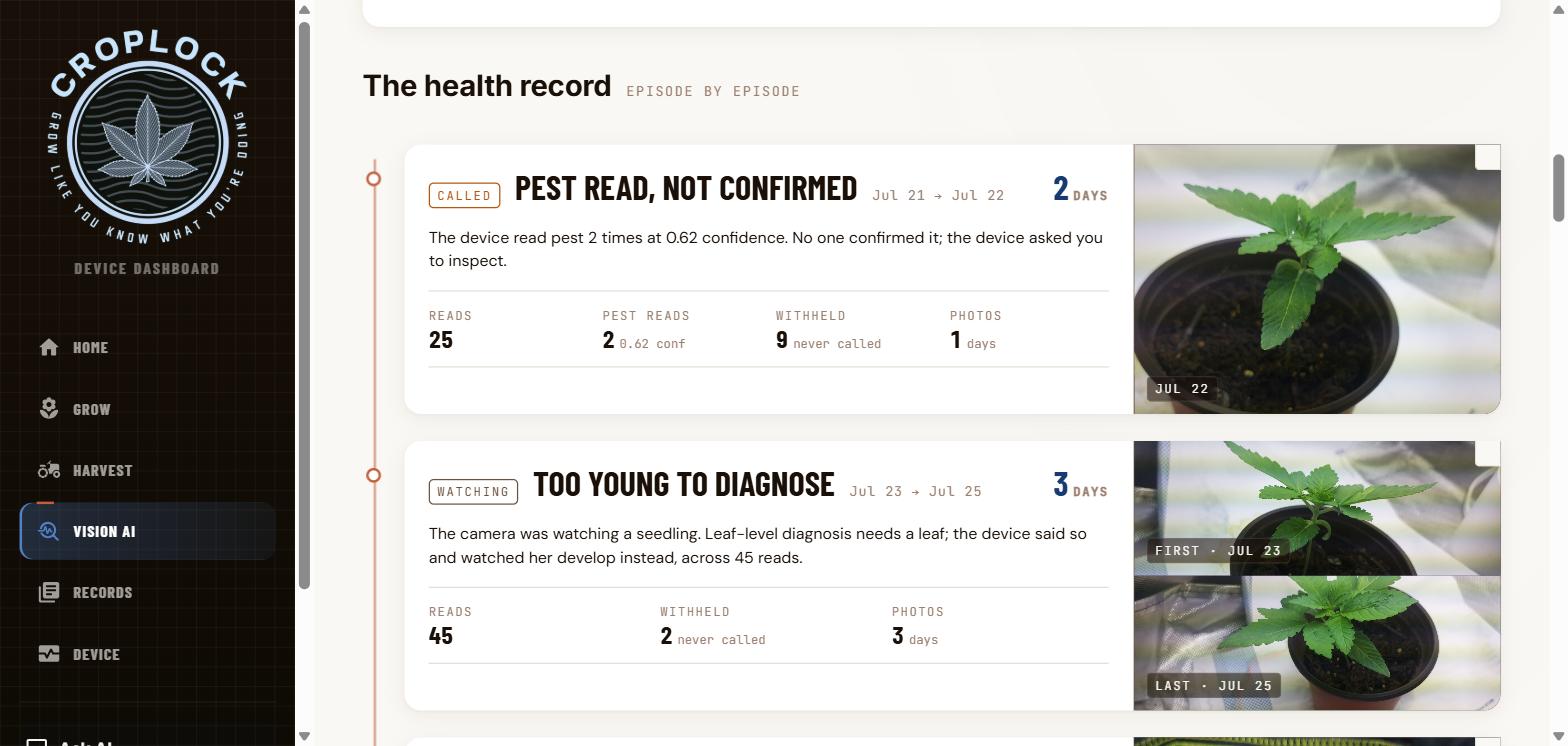
When you look at the plant and decide the camera was wrong, that goes down as well, dated, next to what the camera said. Months later the record tells you what you decided and when — not just what a model thought. It is your grow log, and you are in it.
How these screens are put together, and why — the longer version, for the technically minded.
It can write the story because it’s in every chapter.
A journal is only as good as whoever keeps it up. Croplock keeps this one because it does the watching, the steering and the telling itself — and writes down why.
It watches.
Every minute: the air, the humidity and the leaf itself, with the light at the canopy. Every hour: a photo. Each reading lands in the record with its time and the sensor that made it, so nothing has to be remembered.
It acts — on gear you gave it. It coaches on the rest.
Only the smart plugs you hand it, and only for what you say each one runs: the humidifier, the exhaust fan, a heater or dehumidifier, the lights. It holds the tent in the band your plant’s phase calls for, inside the limits you set, steering on leaf VPD when it has a leaf reading it trusts and saying so when it doesn’t. Every switch it throws is written down with why — and so is every time it decides not to.
Hand it nothing and it is still your coach. It reads the same tent, works out the same move, and tells you what to do with your own hands: bring the humidity down, bring the heat up — and why that one, when the obvious one can’t finish the job. Give it a fan and no heater, and it runs the fan and coaches you on the heat. Start with no plugs at all, and add one whenever you like.
It tells you.
When the tent drifts — heat, humidity, VPD, fungal pressure, a light that never reached the plants — it says so in a plain sentence with what to do, on its own screen first and by email if you give it an address: one story, ranked, with the lever that can close it. When something on the plant looks wrong, it doesn’t guess. It walks you through naming it, a few questions at a time, with the published source behind each one.
Every day gets a page.
All of it lands in one record, so the grow reads back as a story, not a spreadsheet. Open the device and today’s page is waiting: this morning’s frame with what the camera could and couldn’t read written under it, what needs you, and a few short paragraphs put together clause by clause from what the record holds. No model writes it; where the record has nothing, the page says so instead of guessing. One ruled line is yours, because the why is the sentence the grow can’t write for you. Post a page if you like: it is composed on your phone and nothing routes through us — the device never releases anything, and what you choose to share is yours to share.
Your grow is nobody’s business but yours.
Most grow-room AI lives on a company’s servers. Croplock’s lives in your tent: no cloud, no account, no subscription. Your records stay on the device, on your own network, and you can check for yourself that nothing in them has been changed.
Built for the home grower.
It keeps the diary, steers the tent on the leaf, and tells you when it can’t tell. No forms. No jargon. No account.
- Leaf-surface temperature, air temperature and humidity, read continuously — and once the camera confirms it is looking at canopy, Croplock steers on the leaf’s VPD, not the room’s
- Light, measured where it matters — PPFD at the canopy and the daily total it adds up to — the input that actually buys you grams, and the one most growers have never measured. Hand it your light’s plug and it holds your schedule — and on any fault it fails dark, never light, because an interrupted dark period in flower is the mistake you can’t take back
- A daily look at your canopy from the camera — the same photos, kept and compared over time, on the device
- A diary it keeps for you — a page a day, and the whole grow read back as chapters
- It tells you when it couldn’t tell, and shows the count behind every read
- Everything stays on the device, in your house
$649 buys the device, and the intelligence is on the device — so there is nothing left to bill you for. No account to open. No server holding your records. No monthly fee that switches the thinking off the month you stop paying. The founding price is the lowest it will be.
Everything that goes into every grow.

Across the whole grow — not just the easy part.
Today’s page, already written
The device’s Home page is the diary’s page for today, shot live from the bench tent on day 78: the folio, this morning’s frame, what needs you as one story with its lever, a paragraph put together from what the record holds, the leaf read by infrared, and a line that is yours to write. Turn back a day, or to the flip, or to the first photo.
Your grow, read back
One frame a day, kept from the device’s own hourly captures — press play and watch the whole run go by. Underneath, the grow reads back as chapters: what you did, what it measured, what it logged. Nothing is generated for you; it’s your own record, re-read.
Seed packet to started grow
Photograph the packet, front and back — on-device OCR reads it, you confirm, and the grow is started. The photos never leave the box.
An honest harvest window
Every plant gets its own harvest window, projected from its breeder’s flower cycle — a realistic fortnight, per strain, not a fake to-the-day call. Enter the packet’s weeks once; the device keeps the arithmetic.
Dry & cure steering
At the cut, the whole device pivots to the dry room — cool, damp-ish and dark, per the published targets — and if you’ve handed it your gear, it holds the room there. Where quality is made.
A record you own
Nothing is ever edited or deleted — a correction adds a new entry and the old one stays put. It all stays on the box. See a real one.
Schedule III is here. What it actually means for home growers.
On April 23, 2026 the DOJ moved state-licensed medical cannabis from Schedule I to Schedule III. The federal posture shifted toward mainstream legitimacy, but the state laws governing home cultivation didn't change. If your state allowed home grows last week, it allows them this week. If your state didn't, the rescheduling didn't add that right. Don't read federal rescheduling as a new license to grow at home — read it as a signal that the cultural and political environment around home cultivation continues to shift in ways that matter.
What's also true: as cannabis becomes more visible in mainstream commerce, the question of who is watching your data becomes more important, not less. Cloud-based cultivation tracking apps store everything you grow on someone else's servers. That data exists. It can be subpoenaed, breached, sold, or analyzed. Croplock takes the opposite approach: every observation, every photo, every measurement stays on the device in your home. It is built that way from the start — not a promise buried in a privacy policy, but the plain fact that there is no server for it to go to.
Be first when it launches.
Croplock keeps your grow journal for you, steers the tent on the leaf, and tells you when it can’t tell — all on the device, in your home. $649, one-time, no subscription — a founding price for the first growers in. Join the waitlist and you’ll be first when it ships. Prefer to talk sooner? Email us and we’ll walk through your setup.
No spam. We’ll only reach out about availability and the launch price. Unsubscribe any time.
Croplock supports home cultivation in jurisdictions where it is legal. This page is informational and is not legal advice. Cannabis remains regulated under federal and state law; nothing on this page modifies, supersedes, or grants any right under any of those laws. Consult your state's cultivation rules before starting a grow.