
In band, and sick anyway
Nine humid days, one yellow seedling, and the uncomfortable discovery that the number my own device was holding is what did it.
Everything below came off my own hub’s records. It is one plant, in one tent, in July and August of 2026. I’m telling it because the thing that went wrong is the thing I had built the device to prevent, and it still took a person to notice.
Two photographs, forty-eight hours apart
The camera in that tent keeps a frame every hour. Here is the plant on the 29th of July. Nothing wrong with it. The growing tip is a little pale — but look closely and the veins are pale too, the whole tip a uniform light green. That is what new growth looks like. It hasn’t finished building its chlorophyll yet and it darkens over a few days.
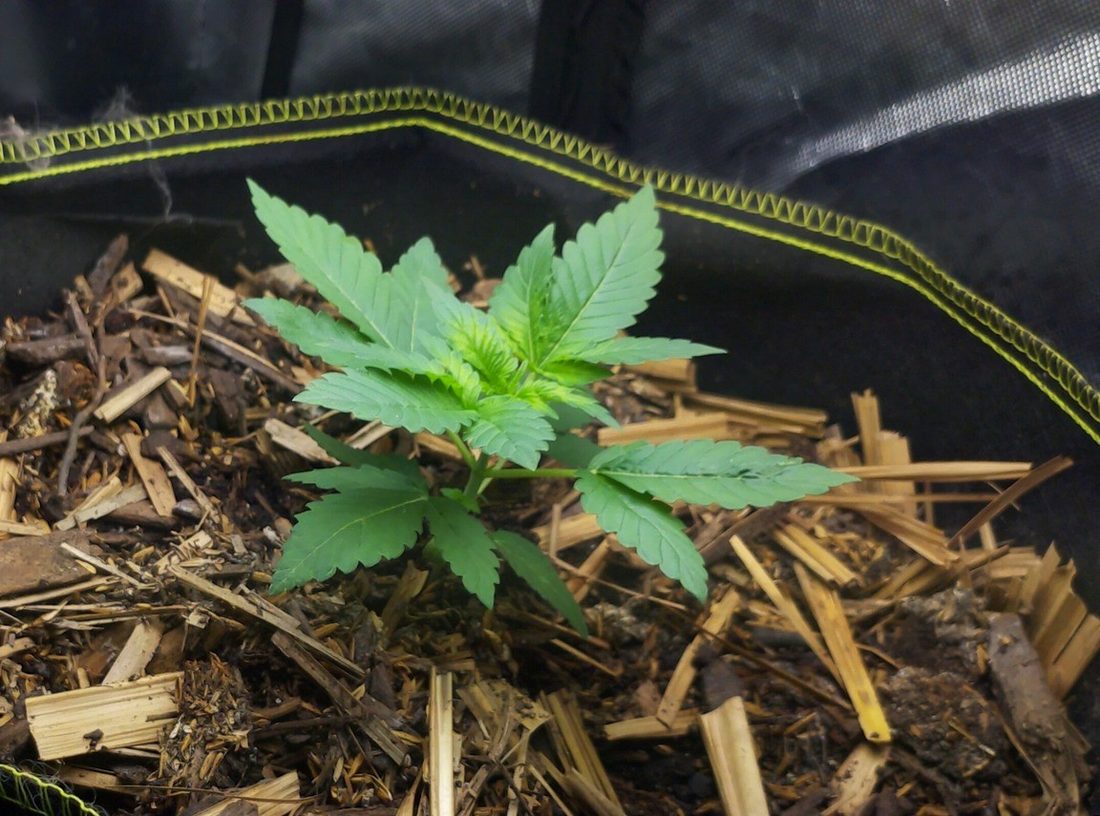
And here is the same plant, same camera, same spot, two days later.
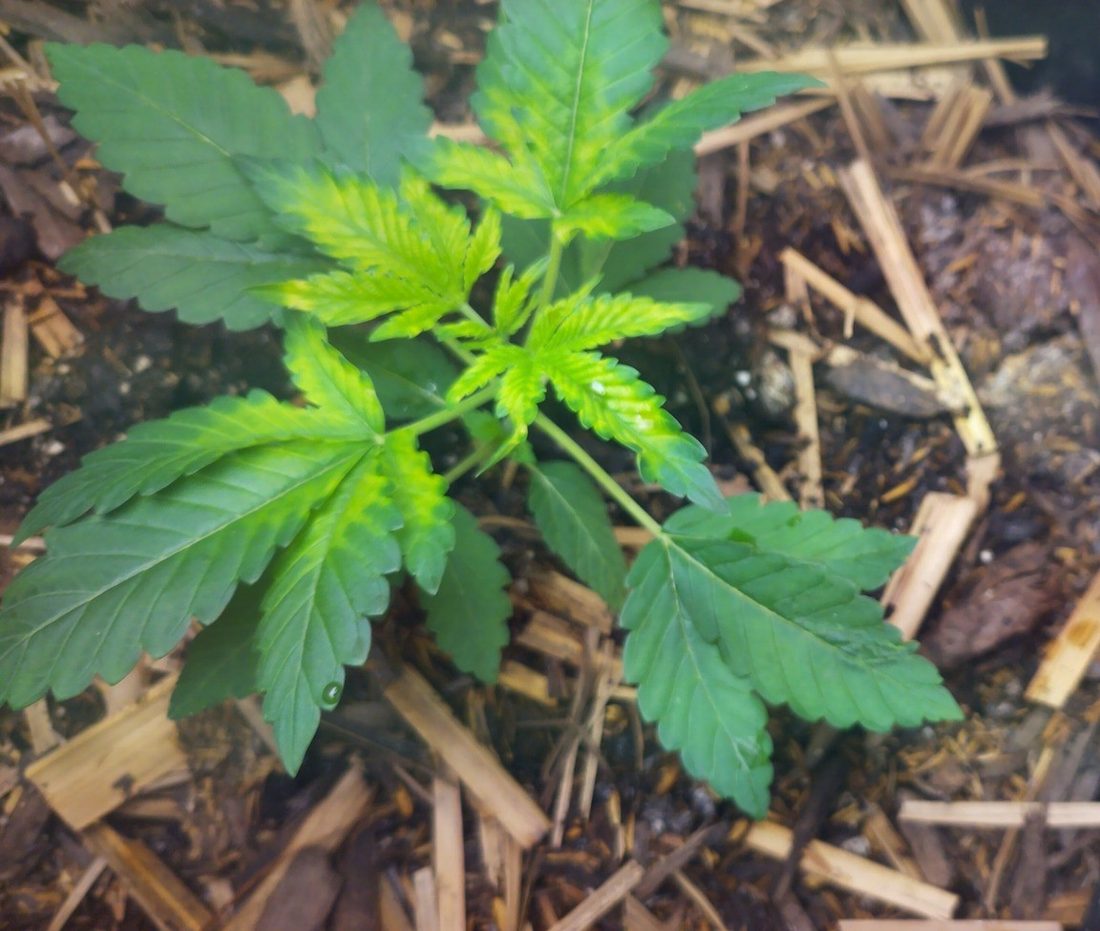
That second picture is a different animal, and the difference is the veins. Pale tissue with green veins running through it is chlorosis. Pale tissue with pale veins is just a plant growing. It is the single most useful thing I know for telling a real problem from a false alarm, and I wrote it up separately at is my pale new growth a deficiency?
The distribution tells you the rest. Damage in the newest leaves with the oldest ones clean means a nutrient the plant can’t move around inside itself — it can’t rob an old leaf to feed a new one. That rules out nitrogen, potassium and magnesium, which strip the bottom of the plant first. Iron fits best; manganese is second.
So I went and read the tent’s history
The hub had been logging temperature and humidity every minute since the run started on 11 July, and nobody had ever looked at the whole thing as a series. When I did, the plant’s short life fell into two halves.
The first four days were hot and dry — high twenties Celsius at somewhere around half humidity. Then it swung the other way and stayed there: from 18 July to 26 July the tent sat between 76% and 82% relative humidity at 23–27 °C, for nine days straight. On the 24th it never left the low end all day.
At that humidity a plant barely transpires. It doesn’t need to — the air is nearly saturated, so there is very little pull on the leaf. And that matters more than it sounds, because iron and calcium only reach new growth by riding up in the transpiration stream. Stop the stream and the newest tissue is the first thing to go short. The timing lines up: the damage window ends on the 26th, the plant is clean on the 29th, and yellow on the 31st. A leaf that was built during those nine days only shows you what it was built with once it expands.
Here is the part I did not enjoy finding
The tent was not out of range during those nine days. It was doing exactly what my device told it to do.
The plant was still in its seedling phase — it didn’t advance to veg until 27 July — and the target range my own knowledge pack specifies for a seedling is 0.40 to 0.80 kPa of vapour pressure deficit. That is a legitimate, mainstream number, and for the first week of a rootless little thing that cannot yet replace water it loses, it is probably right. But hold that band at 24 °C and the arithmetic demands about 80% humidity. Down at the low edge it demands 86–89%. Which is to say: the band is a near-zero-transpiration instruction. Holding it correctly and starving new growth of iron are the same act.
So every surface on the device said the tent was fine, and every surface was right. The plant was inside its band the entire time it was getting sick. Worse: once the run advanced and the control loop was running, the device would have actively humidified to keep it there.
What the pack encoded was a static band with no ramp and no exit — no notion that the right target moves as roots establish, and no limit on how long a plant may be held at the seedling setting. The harm was never the value. It was the duration. And nothing alarmed, because every guard I had written watches for a band being missed. None of them watched for a band being held too long.
Why the leaf sensor wasn’t there when it mattered
There is an infrared sensor in that tent whose whole job is to read the temperature of the leaf itself, so the device can work out the vapour pressure deficit the plant actually experiences rather than the one the room does. I’ve argued elsewhere that this is the only honest way to compute VPD.
It contributed nothing to this episode, and the reason is not a bug. The device refuses to believe a leaf reading unless the camera can confirm the sensor is actually looking at canopy — point an infrared thermometer at soil or a tent wall and it will cheerfully report that surface’s temperature as your leaf. Through the whole humid stretch the plant was a few tiny leaves in a large pot. There was no canopy to confirm. The device knew it didn’t know, and said so, which is the behaviour I want — but it means the leaf number was unavailable precisely when it would have been most useful.
It arrived on 2 August, once the plant had filled out enough for the camera to vouch for it. The first thing it said was worth the wait. On the air, the tent read 1.035 kPa: comfortably fine. Eight minutes later, measured off the leaf surface, it read 0.612 — below the floor. Two numbers, same tent, same morning, about the width of an entire target band apart. The room had been fine for five days. The plant had not.
What actually fixed it
Two things, that afternoon, which is annoying, because it means I can’t fully separate them.
I turned the fan up. On the leaf frame the tent came up off the floor and has stayed up since. And I gave the plant a single foliar dose of chelated iron — one pass, on the leaves, and deliberately not repeated.
Not repeating it was the point. Iron applied to a leaf stays in that leaf; it does not travel onward into growth that hasn’t emerged yet. So a second spray would have greened up the new leaves too and told me nothing. By leaving them alone I got a free read on whether the underlying problem was actually gone.
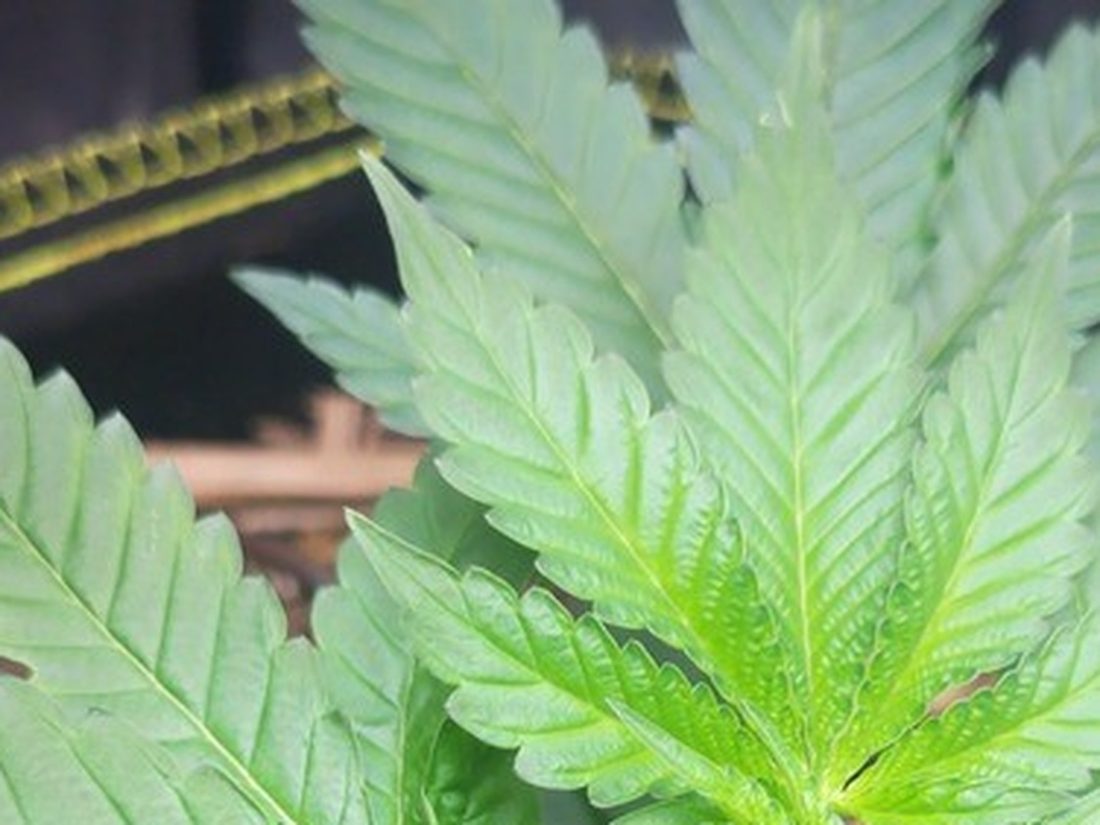
The leaves that were already yellow went green again within a couple of days. That is the spray, almost certainly — that speed is what foliar iron does, and it is also a useful piece of evidence in its own right: iron on a leaf turning that leaf green means the leaf really was short of iron.
The part that answers the actual question is everything that has grown since. Three weeks of new leaves, none of them sprayed, all of them coming in green and staying green. That is the underlying constraint being gone, not a cosmetic patch.
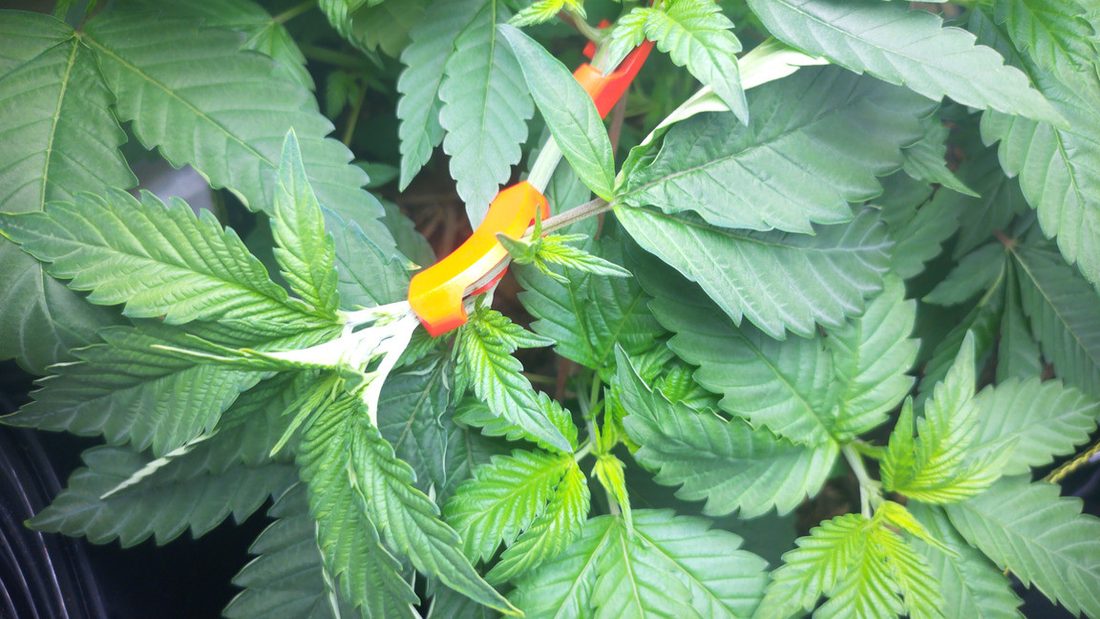
I’ll be honest about the limit: I know the conditions were present for nine days, I know the pattern and the distribution point at iron, and I know it resolved when the air moved and stayed resolved in tissue the spray never touched. I do not have the root zone fully pinned down. That pot is fed by a wick from a reservoir underneath, so it never gets a flush — nothing ever drains through it — and the likeliest remaining piece is that salts and pH crept upward in the top of the medium where a bulk pH test averages them away. Mine read 6.62, which is not a lockout number. That is a thread I’m still pulling.
What I changed in the device
Three things, all in the first week of August.
The seedling band now ramps. It holds the tight early target for a set number of days and then walks itself toward the vegetative band, because the correct number for a rooted plant is not the correct number for a cutting, and a static value can only be right at one moment.
There is now a guard that refuses to keep humidifying a tent that has already been saturated for days — the setpoint no longer gets the last word over the consequence. And the device now says something when a plant has been sitting in its seedling phase longer than that phase is supposed to last, because “seedling” had quietly stopped describing anything real.
I’d rather tell you the honest state of those: they are proven by tests, not by hardware. My bench tent is a healthy vegetative room and neither guard has had a real reason to fire yet. They will get their first real test on somebody’s actual seedling, and I’d rather say that than let you assume otherwise.
The bit that stays with me
My device had three weeks of readings taken every sixty seconds. It classified every single one of them correctly. And it never said the one thing that mattered, which was: this has been going on for nine days.
Alarms fire on crossings. Something goes out of range, you get told, and then it stops telling you because nothing new has happened. That is the right design for an alarm and it is useless as a memory. Slow, quiet, in-range harm is exactly what a person cannot see by looking at a plant every day — and exactly what a box that never stops watching should be able to see on their behalf.
It didn’t. I did, by squinting at a photograph and noticing the veins were the wrong colour. That is the gap I’m building against, and this grow is the reason I know it’s real.
The rest of that grow, day by day, is at One plant, one tent, as the device wrote it down. More on the leaf-versus-air question at Answers. Why the Grow page and the camera record look nothing alike: A register and a diary. The device is at croplock.com, and if you want to hear when it’s ready, join the waitlist.